Ownership
A car's compulsory costs do not flex with the purchase price
The price is the figure that sticks in your mind from the purchase. After that a second bill begins: vehicle tax, motor insurance and roadworthiness inspections run on whether the car cost 3,000 or 6,000 euros. The compulsory charges are set by the car's mass, fuel and age, not by what was paid for it. That is why the odometer tells you more about the costs ahead, and in the 3,000–5,999 euro bracket its median reading is 266,000 km.

maksimi.fi
06/08/2026| 12:42 | 20 min read
In brief
- The base component of the vehicle tax for a passenger car is 106.21–654.44 euros a year, and where you land in that range is set by carbon dioxide emissions, not by the car's value.
- A passenger car over 10 years old is inspected annually, and the median model year of a car sold in the 3,000–5,999 euro bracket is 2008.
- A diesel is charged a fuel component based on total mass, and in this bracket 40.8% of sales are diesels, against 31.7% across the market.
How much does owning a car cost per year on top of the purchase price?
There is no single right figure, but the costs fall into two groups that behave differently. The first runs even if the car sits on the drive all year: vehicle tax, motor insurance and periodic inspection. The second arises only from driving: fuel, tyres, scheduled servicing and repairs. At the point of purchase people usually work out the second, even though the first is the one a buyer can no longer influence once the deal is done.
The split matters because it explains why two people get different annual costs out of the same car. The driving-related part scales with your own mileage: someone who drives little pays little for fuel and wears tyres slowly. The sitting-on-the-drive part does not scale at all; it is the same for someone doing five thousand kilometres a year and someone doing fifty thousand.
How long you keep the car decides which group weighs more. Over one year of ownership the baseline load and any surprise repairs are the whole bill. Over five years tyres, the cam belt and other longer-interval replacements come in, and they fall in different years. The same car can therefore look cheap in its first year and expensive in its third, even though nothing has changed.
The size of the compulsory charges is read from the registration certificate, not the bill of sale. Vehicle tax is set by carbon dioxide emissions and total mass, the inspection interval by the date of first registration, and motor insurance by the car's technical details together with the driver's history. None of them asks what was paid for the car. The same tax and the same inspection interval apply to a thousand-euro car and a ten-thousand-euro car if the technical details match.
A cheaper car therefore does not automatically mean a cheaper year of ownership.
You can get a sense of the scale from what sort of car changes hands at this price. In July 2026, 7,621 cars sold for 3,000–5,999 €, which is 14.4% of all sales that month. The bracket's median price was 4,450 €, its median model year 2008 and its median mileage 266,000 km. Those three figures predict the year's costs more accurately than the price tag, because they tell you the car's age and how much it has already been used.
All listings currently for sale, across every price bracket.
Which costs run even if the car sits on the drive?
According to Traficom, a car in road use must have valid motor insurance, and it is paid for regardless of kilometres driven. Vehicle tax is charged for every day the car is in road use. The periodic inspection comes round by the calendar, not the odometer. Those three make up the year's baseline load, which exists before the car has been touched.
The size of the insurance premium depends on the insurer, the driver's claims history and the car's details, so it cannot be read off a single table. The structure is still the same for everyone: the premium is charged for time, not for driving. The same goes for vehicle tax, which accrues one day at a time whether or not the car is ever started. Both continue while the car is in the workshop or broken down.
The only way to break the baseline load is to take the car off road use. Both the vehicle tax and the obligation to insure stop for that period, but the car may not be driven either. For a seasonal car and for a hobby car laid up over winter this is a real option; for a car in daily use it is not.
The baseline load is also the part that catches out a first-time buyer. The advertised price is paid once, but tax and insurance start running the moment ownership changes, and the first inspection can fall a few months after the purchase. If the car was bought just before an inspection, the first year of ownership includes both the inspection and any repairs. It is worth checking the timing of these before the budget is settled.
How much is the vehicle tax and what sets it?
Vehicle tax has two parts. According to Traficom the base component for a passenger car is 106.21–654.44 euros a year, and where you land in that range is determined by the car's carbon dioxide emissions: the higher the emissions figure, the higher the tax. The emissions figure is on the registration certificate, so the tax can be checked before the purchase and does not have to be guessed.
The second part is the fuel component, charged when the fuel is something other than petrol. According to Traficom it is 5.5 cents per day for each started hundred kilograms of total mass for a diesel, 1.9 cents for electric and 3.1 cents for methane. Because the multiplier is mass, a heavier car pays more regardless of what it cost to buy.
This is why the compulsory tax on a cheap diesel is higher than on an equally cheap petrol car. The fuel component does not flex with value at all; it grows as mass grows. The gap is larger the heavier the car, and it repeats every year of ownership. Over ten years it is not a one-off difference but ten consecutive ones.
Not every car has an emissions figure in the register at all. According to Traficom the base component is then determined by the car's total mass, and in practice this applies to the oldest cars. Both bases are part of the car's technical data, and neither changes with what was paid for the car.
Vehicle tax is therefore the only annual cost that can be worked out in advance to the euro. The emissions figure and the total mass are on the registration certificate, and from them you get both the base component and any fuel component. It is worth doing before the purchase, because the figure does not change through negotiation.
How often is a car this age inspected?
According to Traficom a passenger car is inspected for the first time no later than four years after the date of first registration, and thereafter no later than two years after the previous inspection. Once more than 10 years have passed since first registration, the car must be inspected annually.
In this price bracket that threshold is passed in practice every time. The median model year of a car sold in the bracket is 2008, against 2015 across the market. That is a seven-year gap, and it means an inspection every year rather than every other year. Over ten years of ownership that is ten inspections instead of five.
The inspection fee itself is only part of the bill. If there is something to fix, a failed inspection means a re-inspection and, before it, a repair that has to be done if the car is to stay on the road. In an older car an advisory or a failure is more likely, so the annual interval is not only more frequent but on average a more expensive occasion.
A recent inspection is not the same thing as a low annual cost either. The seller may have had the car inspected just before selling it, and that tells you the car passed on that day. It does not tell you what will wear out over the next year. An inspection measures a moment, not the service life left.
The shorter interval has another side to it. A fault comes to light sooner than in a car inspected every two years, so it has less time to grow into serious damage. What matters for a buyer is knowing when the last inspection was done: if the next one is a month away, it belongs in the first year's budget, not the second's.
Why does the odometer say more about future costs than the price?
A price bracket is bounded by price, so within it price no longer tells cars apart. Mileage does. In July the median mileage of a car sold in the bracket was 266,000 km, but the spread around that median is wide, and it is spread within the same price.
At one extreme is the Volkswagen Transporter, which sold in this bracket with a median reading of 417,000 km. The same money also bought a Ford Fiesta, whose median reading in the bracket is 152,000 km.
The same price, but the distance covered is in a different league.
The wearing parts do not look at the price tag but at the kilometres. The cam belt, clutch, dampers, brake discs and exhaust are replaced according to use, so a car driven to the Transporter's reading is closer to the next replacement in most of them than one driven to the Fiesta's. The annual costs of two cars at the same price can therefore differ several times over, even if both are mechanically sound on the day of the sale.
The same shows between body types. The estate is the bracket's most common body with a 28.1% share, and its median reading is 307,000 km, against 194,500 km for a hatchback. At this price an estate is therefore typically a car driven further, even though the price is the same. The body tells you about use; the price does not.
The spread of price within the bracket is small compared with the spread of kilometres. A quarter of the deals were done below 3,699 € and a quarter above 5,200 €, so the price band is narrow. In kilometres the gap between the extremes runs to hundreds of thousands. When one variable moves a little and the other a lot, the latter explains more.
Does a diesel cost more than a petrol car?
Diesel is over-represented in this price bracket. In July 40.8% of the bracket's sales were diesels, against 31.7% across the market. Petrol accounted for 58.1% in the bracket and 42.7% across the market.
The diesel's advantage is lower consumption, but on an annual basis two things work against it. The fuel component is charged only on fuels other than petrol, and the median mileage of a diesel sold in this bracket is 342,700 km, against 220,000 km for a petrol car. For the same money a diesel is therefore on average a car driven further, and the gap is more than a hundred thousand kilometres.
Which works out cheaper depends on your mileage. For someone who drives little, the fuel component and the higher reading eat up the fuel saving; for someone who drives a lot, the difference in consumption has time to cover them. The dividing line cannot be read off a price tag; it is worked out from your own annual mileage.
This is why the same car can cost two buyers different amounts without any difference in the car. Someone doing a few thousand kilometres a year in town pays the fuel component on a diesel and gains little from the consumption difference. A commuter racking up tens of thousands of kilometres is in a different position, and for them the sums come out the other way round.
The weighting towards diesel also shows in the body types on offer. The SUV accounts for 8.4% of the bracket's sales, against 21.5% across the market, and the bracket's SUVs have a median reading of 301,000 km. A bigger body means a bigger mass, and mass is exactly what the fuel component is calculated from.
Does an electric car solve this?
An electric car's running costs are lower, and its fuel component is 1.9 cents per day per hundred kilograms rather than the diesel's 5.5. In this price bracket, though, the option is not really available. In July 0.1% of the bracket's sales were electric cars, which in units means six deals in the whole month.
Across the market the electric share was 10.7%, many times that of this bracket. The gap comes down to price: the median price of an electric car across the market was 34,900 €, while this bracket stays under six thousand.
An electric car is therefore a product of a different price bracket, not an option within this one.
The same goes for hybrids. Hybrids made up 0.5% of the bracket's sales and plug-in hybrids 0.1%, against 6.8% and 7.7% across the market. In the cheapest brackets the choice is in practice petrol or diesel, and it is made between those two.
This matters because cutting running costs by switching technology requires a larger purchase price. When the budget is in this bracket, annual costs are influenced by choosing a lighter car, a lower emissions figure and a lower odometer reading. Switching fuel is not one of the available levers.
The fuel is worth checking on the registration certificate rather than in the ad's headline. The fuel component is determined by the fuel recorded in the register, and that decides whether there is a charge at all: no fuel component is levied on a petrol car. The fuel is usually stated in the ad, but the tax follows what has been entered in the register.
Why are tyres an annual cost rather than a one-off purchase?
Tyres are a compulsory wearing part, replaced by the calendar as much as by wear. According to Traficom, winter tyres must be used in Finland from 1 November to 31 March if the weather or road conditions require it. The main grooves of a winter tyre must be at least 3.0 mm deep and those of a summer tyre at least 1.6 mm.
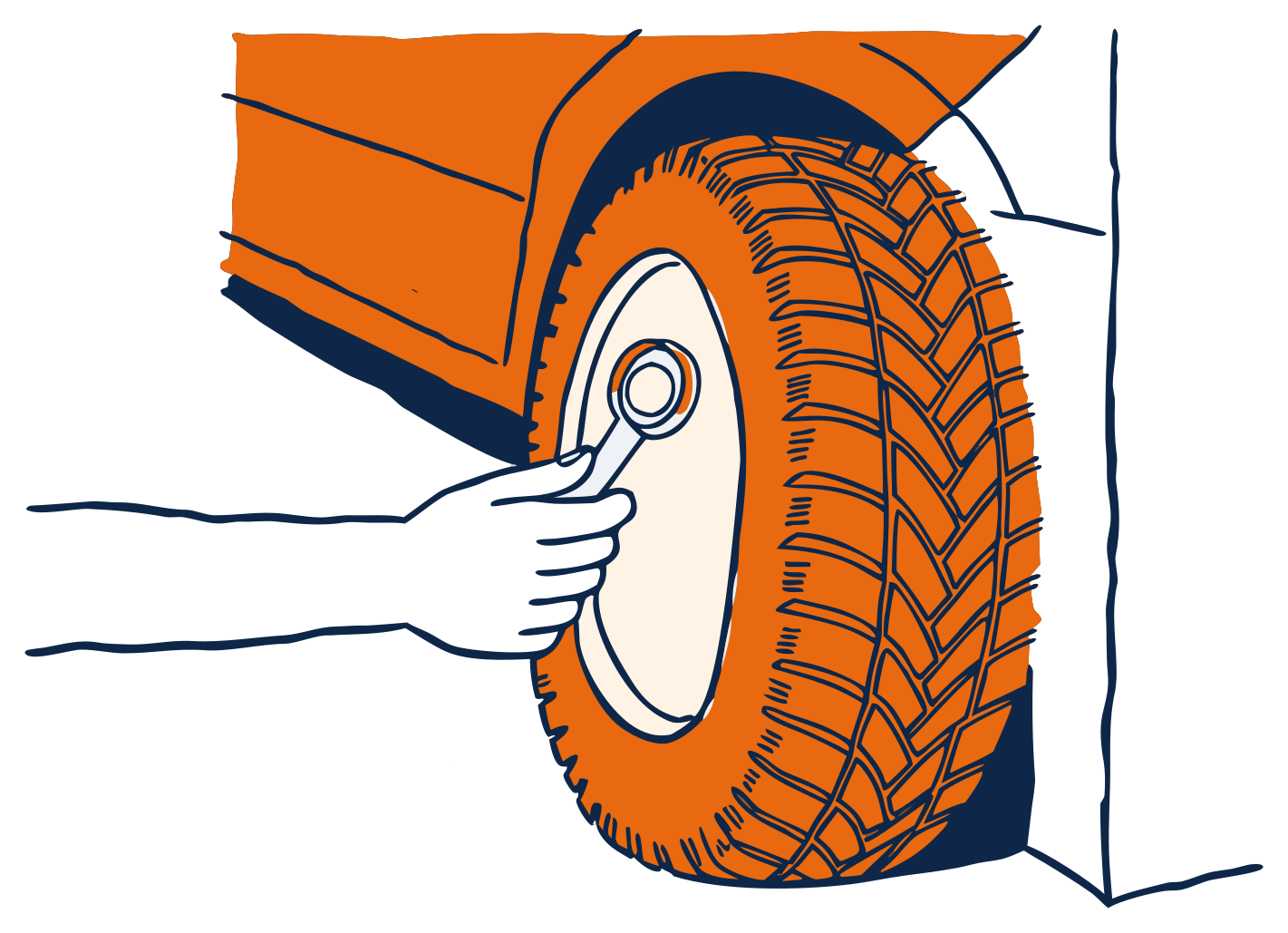
Keeping two sets of tyres is therefore a requirement rather than a choice, and each set has its own service life. As an annual cost this comes to the price of a set divided by the years it lasts, plus the twice-yearly changeover and storage for the set not in use. Neither can be avoided on the grounds that the car was cheap.
Tread depth is worth measuring before the purchase rather than after the first frost. In a car driven a long way the tyres are rarely new, and if both sets are worn out, two sets land on top of the purchase price straight away. It is the single most common way in which a cheap car's first year turns out dearer than expected.
Tyre size affects the sum. A larger wheel and a wider tyre cost more per set, and the same size comes round every time the set is replaced. The size is on the registration certificate, so that too can be checked before the car is bought. On tyres the buyer of a cheap car therefore pays exactly the same as the buyer of an expensive one, if the tyre size happens to match.
The tyre cost does not flex with the car's age or price. The median price of a 2013 car in the bracket is 4,900 € and of a 2005 car 3,990 €, but a set of tyres costs the same for both if the size is the same. The cheaper the car, the larger the share of annual costs the tyres take.
What do servicing and repairs cost on an old car?
Servicing prices cannot be given as one figure, because they depend on the model, the engine and the workshop. The structure is still the same in every car: scheduled servicing comes round by kilometres or months, and on top of it come the wearing parts as they run out. The first part can be planned for, the second cannot.
In an old car the second part is larger. The median model year in this price bracket is 2008, meaning the car has typically reached an age at which the cam belt, cooling system, exhaust and suspension are all towards the end of their life. A single repair can exceed the car's purchase price, and that is exactly what makes the annual cost uneven: two cheap years and one expensive one.
The gearbox is worth looking at separately. The median mileage of an automatic sold in the bracket is 315,000 km, against 242,000 km for a manual. Manuals account for 63.4% of the bracket's sales, so at this price an automatic is both rarer and driven further.
The type of seller shows at the same point. The median reading of a car bought privately in the bracket is 292,000 km and of one bought from a dealer 241,000 km, with median prices of 4,000 € and 4,890 €. Dealers account for 43.7% of the bracket's sales, against 66.0% across the market: the cheaper the car, the more likely it is to be sold privately.
Parts availability is worth a thought too. 649 different models changed hands in the bracket, and they differ widely in how easily and cheaply a part can be found. The most traded was the Volkswagen Golf with 237 sales and the second most common the Skoda Octavia with 213. Parts for a common model are widely available, for a rarer one perhaps not at all, and the difference shows both in the price and in how long the car sits in the workshop.
Can a more expensive car be cheaper to own?
Price is not entirely unrelated to a car's condition, and this argues against what has been said above. At a higher price cars are newer and less driven: the median mileage across the market is 177,476 km, against 266,000 km in this bracket. A more expensive car has therefore on average had less time to wear out, and it has fewer replacements ahead of it.
This does not undo the fact that the compulsory charges do not flex. Vehicle tax, motor insurance and inspections do not get cheaper because the car is cheap. They follow the car's characteristics, and their share of a cheap car's total costs is larger simply because the divisor is smaller.
Within a price bracket, price does not predict age either. The median price of a 2017 car in the bracket is 5,490 € and of a 1990 car 4,200 €. The price therefore moves only a little, even though the age gap is twenty-seven years. In annual costs the same age gap shows up far larger.
The right conclusion is not that a more expensive car is always cheaper to own, but that price and annual cost are two different quantities. Sometimes they coincide and sometimes they do not, and both can be checked separately before the purchase. The odometer and the registration certificate tell you about the second; the purchase price tells you nothing about it.
A second objection concerns tied-up money. A difference of thousands of euros in the purchase price is a real cost just as tax and insurance are, and it is paid up front. Comparing annual costs does not replace comparing purchase prices; it comes alongside it.
How do you work out the annual costs for the car you are buying?
The calculation is worth doing before the purchase, and all it needs is the registration certificate, the odometer reading and your own estimate of annual kilometres. Work out the baseline load first, because it is the only part known for certain. Into it go the vehicle tax, an insurance quote and the inspection fee.
The vehicle tax comes from the emissions figure and total mass on the registration certificate. An insurance quote can be obtained in advance from the car's details, so that is not guesswork either. The timing of the inspection follows from the date of the last one, and on a car over 10 years old it repeats annually.
After that comes the driving-related part. Fuel follows from your own annual mileage and the car's consumption, tyres from the price of a set divided by the years it lasts, and servicing from the manufacturer's service schedule. It is worth setting aside a separate allowance for repairs, and the higher the odometer reading, the larger it should be.
The figure you get this way is not exact, but it is in the right order of magnitude and it is comparable. Do the same calculation for two cars under consideration and the difference shows immediately rather than a year later. Comparability is the value of the exercise, not its last decimal place.
It is worth noting down what you do not know as well. The size of the repair allowance is an estimate, and it can be entered as a range rather than a single figure. When two cars are worked out by the same method, the imprecision of the estimate applies equally to both and does not distort the comparison.
What does this mean for a buyer?
Everything that affects the annual costs can be seen before the money changes hands. The registration certificate shows the emissions figure, total mass, fuel and date of first registration, and from those you get the vehicle tax and the inspection interval. The odometer tells you how close the wearing parts are to replacement.
The difference between two cars at the same price comes from exactly these. A light petrol car driven less than the bracket's median is cheaper to own than a heavy diesel driven more, even if the purchase price matches to the euro. The difference does not show in the ad, only a year later.
The same check is worth doing on the car's condition, and there is a test drive checklist for that. The relationship between mileage and price is covered in more detail in the article on mileage in the cheapest price bracket, where the same effect is even more pronounced.
The price tag tells you what you pay once. The registration certificate and the odometer tell you what you pay every year. Of the three, only the first is printed large in the ad, and that is precisely why the other two are worth looking up yourself.
This price bracket is large precisely because it is the one many people can reach. Working out the annual costs does not make the car cheaper, but it moves the surprise out of the first year of ownership. After that the budget also survives the year in which some larger part is due. If the car has already been bought, the same calculation tells you which month the inspection and the tyre cost fall in, and the value of that too is that the bill does not arrive unannounced.