Ownership
A car fails its inspection underneath, not on the dashboard
On the morning of the test, plenty of people wipe the lights clean and top up the screenwash. The failure almost always comes from somewhere the driver cannot see from the seat: axles, wheels and suspension accounted for 308,940 defects that caused a failure in the 2025 periodic inspections, more than any other category on the car. Brakes come second. Below are the five points where preparation most often goes to waste, and what you can do about each of them a week earlier. Most of them can be checked on your own drive without special tools.

maksimi.fi
26/08/2026| 05:40 | 19 min read
In brief
- One in four periodic inspections ends in a failure: the failure rate is 26.9%.
- Repair notices came to 1,002,794, more than the number of defects that caused a failure. They mark the places that did not bring the car down this time.
- Of cars first registered in 2021, 8.2% failed; of those first registered in 2005, 44.3% did. Median odometer readings in the same two groups are 66,000 km and 257,000 km.
Axles and suspension bring down the most inspections
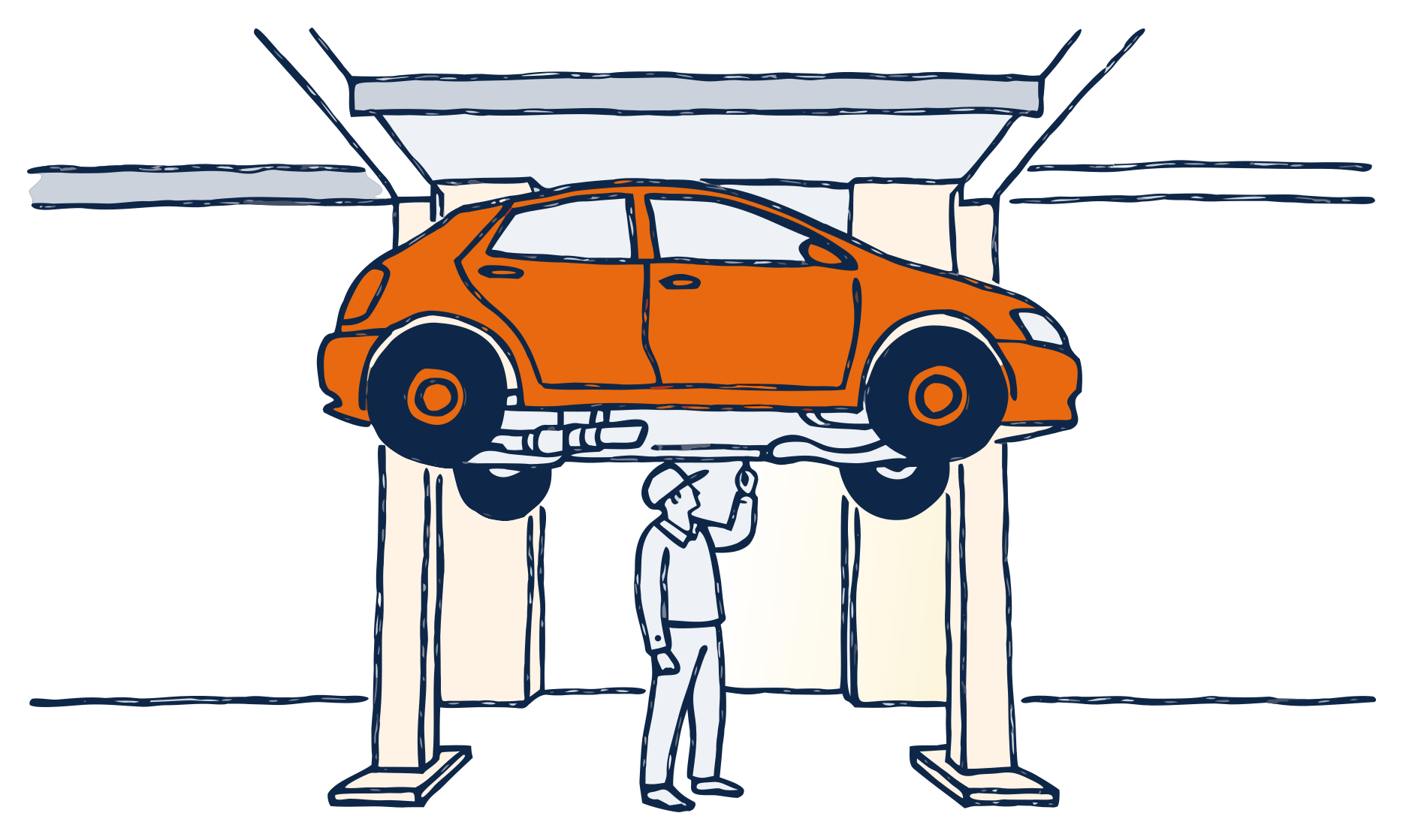
Preparing for a roadworthiness inspection (katsastus) is best started underneath the car. In the 2025 periodic inspections, axles, wheels and suspension accounted for 308,940 defects that caused a failure. That is more than brakes, steering and lighting put together, and it is also the part of the car a driver never sees from the seat and rarely sees at all, unless the car happens to be up on a lift. Screenwash, clean glass and a vacuumed interior move that figure in neither direction. Yet they are exactly what there is time for on the morning of the test.
- Axles, wheels and suspension 308,940
- Braking systems 217,030
- Environmental nuisance 79,258
- Chassis and body 74,872
- Steering 50,651
- Lights and electrics 13,209
The same pattern continues on the rows below. Chassis and body collected 74,872 defects that caused a failure and steering 50,651, and together with suspension and brakes these are all categories that cannot be seen without a lift. Lights and electrics stop at 13,209 defects, even though bulbs are precisely what gets changed the evening before the test. The ratio is no accident. A blown bulb is visible to the driver immediately; play in the suspension never is.
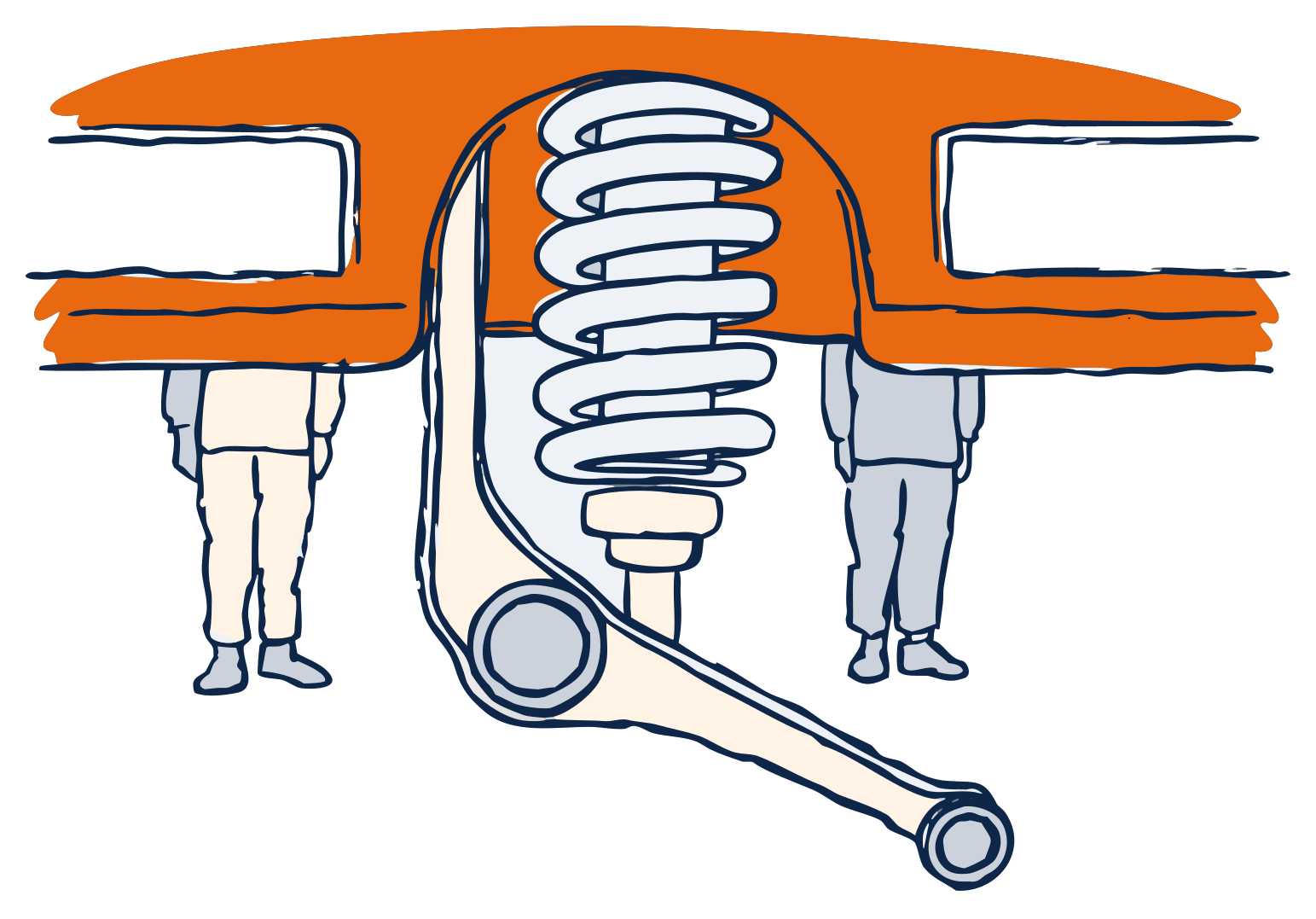
Wear in the suspension is slow and almost always symmetrical. A ball joint loosens, control arm bushes soften and a damper loses its damping bit by bit, so the car does not start to feel broken, only softer. Over a few weeks the driver adjusts to the new feel without noticing it: corners are taken more gently, speed bumps are crossed more carefully, and the thud of a kerb sounds the way it has always sounded. Nothing observed from the driver's seat gives warning in time, because the point of comparison slides along with the car. The inspector, by contrast, takes hold of the wheel and rocks it. Either there is play or there is not, and it needs no interpreting.
You can run the same test on your own drive with a jack and an axle stand. Raise the front of the car, take the tyre at the twelve o'clock and six o'clock positions and rock it back and forth: a knock or clear movement means play in the wheel bearing or in a suspension joint. Repeat the grip at three o'clock and nine o'clock, where movement points to the steering joints instead. Lower the car, press each corner down in turn and let go. If the body keeps rocking for more than one bounce, the damper is finished. While you are there, look at the damper body: an oily streak down its side means the seal has gone.
One figure does not yet say how common failing is. There were 1,672,937 periodic inspections, and 26.9% of them ended in a failure. Defects that caused a failure came to 783,266, but repair notices were more numerous still, at 1,002,794. Repair notices are defects that did not cause a failure, and there are a good quarter more of them than there are actual failure lines. They mark the places where the car was already at the limit but not yet past it. That is why the inspection certificate of an older car is worth reading to the end rather than only down the first line. It is the repair notice lines that most often become failures next time.
The brakes feel fine and still lose on the rollers
Braking systems accounted for 217,030 defects that caused a failure, the second highest of any category. To the driver, though, brakes are the part of the car tried out every single time it moves off, which is why they are treated as already checked. The only point of comparison is yesterday's braking in the same car, and the performance fades on both sides at the same rate. The pedal feels familiar even when the distance to a standstill has grown by metres.
The difference between a worn brake and a sound one does not show in the braking that starts early and ends under control. It shows in the one situation a year that brakes exist for, and that situation cannot be rehearsed in advance. The feel of the pedal says nothing about it, because that feel follows fluid pressure rather than the thickness of the friction surface.
Two things almost never get tried in everyday use. The handbrake is the first of them: in an automatic, it may not be pulled once over a whole winter, and that is exactly why the cable seizes in place. The second is the brake pipework, which runs along the underside of the car through salt and grit and rusts from the outside in. It gives no sign of itself until it leaks, and then the sign arrives all at once. Neither can be spotted by driving, because neither takes part in ordinary braking.
Look at the face of the brake disc between the spokes of the wheel. A sharp lip raised at the outer edge means the disc has worn thin in the middle, and deep scoring across the face means the same thing. Pull the handbrake on a gentle uphill slope and see whether it holds the car or lets it creep. Finally, run a finger along the brake pipes underneath, at the point where they pass closest to a wheel: rust that has lifted into a crust and flakes off is a different matter from an even brown film, and it is a failure line rather than a repair notice.

What the brake disc and the suspension joint have in common is that both need the car off the ground. One part of the same assembly, however, can be read off a car standing still without even bending down properly, and it is also the part the inspection measures with a gauge rather than judges by eye.
With tyres the limit is measured in millimetres
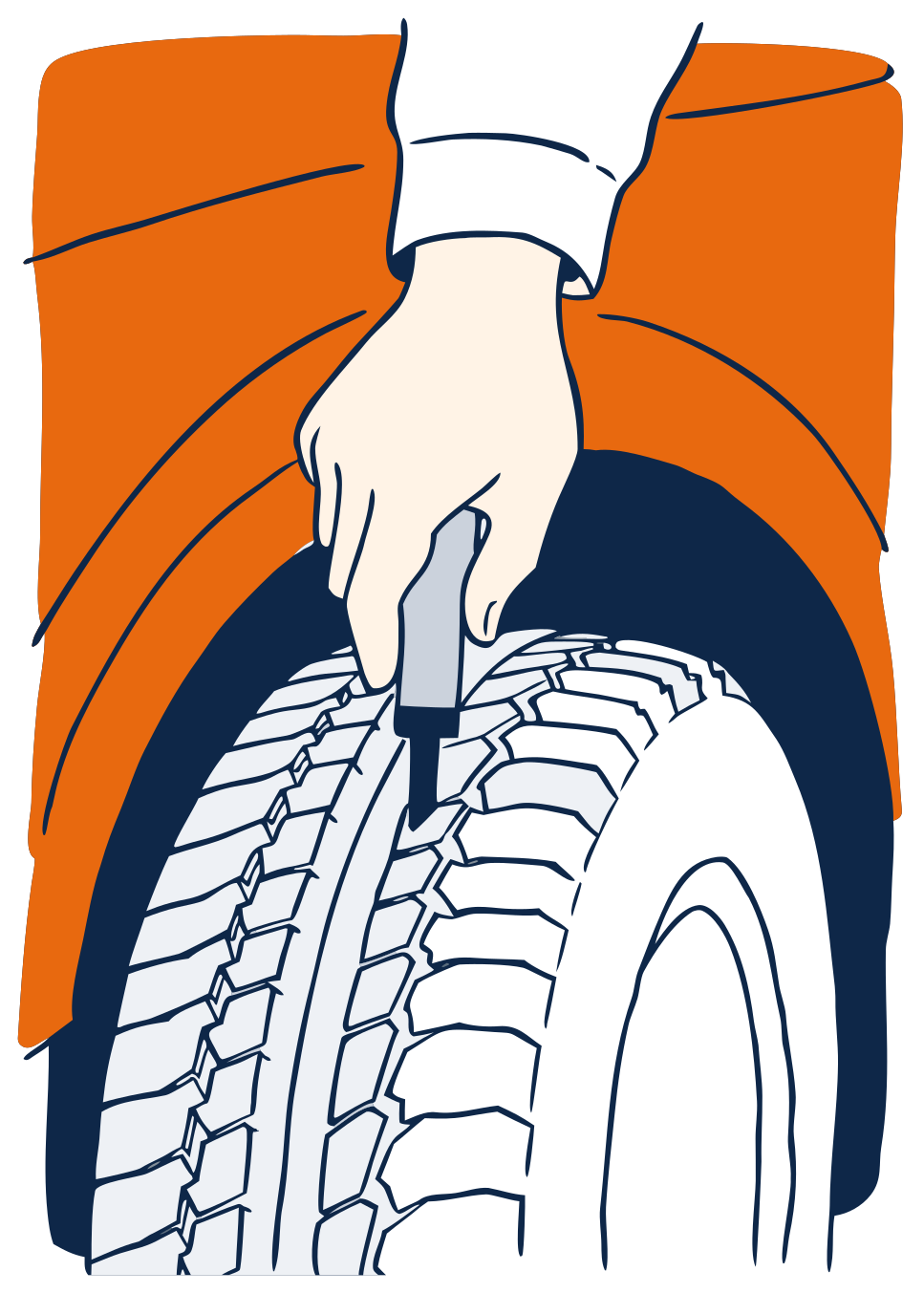
Tyres belong to the same main category as the suspension, but they are the only part of it anyone can measure at home without a lift. According to the Finnish Transport and Communications Agency (Traficom), the law requires the main grooves of the tread to be at least 1.6 mm deep on summer tyres and at least 3 mm on winter tyres. The limit is absolute. It is not rounded up on the grounds that the tyre is otherwise sound or that new ones are already on order.
Nor does the winter tyre season bend to fit the test date. According to Traficom, winter tyres must be used in Finland from 1 November to 31 March if the weather or road conditions require it, so the same car may end up on the lift with either set fitted. The calendar settles nothing about the condition of a tyre in either direction: a summer tyre is not passed because it is July, and a winter tyre is not passed because there happens to be no snow that particular day.
Measure from the bottom of a main groove at several points across the width of the tyre, not only in the middle. Turn the wheels to full lock and look at the inner edge, which is usually the more worn of the two and also the one you never see when the car is parked. If the inner edge is clearly more worn than the outer one, the fault is not in the tyre but in the wheel alignment, and it leads straight back to the suspension. A new tyre fitted in place of the old one will then wear the same way. Check the sidewalls last: a bulge or a crack in the side does not get better with more air pressure.
Two things usually go unmeasured altogether. The first is tyre pressure, which drops by itself over a winter and wears the tyre at the edges even when the alignment is right. The second is the age of the tyre. Rubber hardens over the years regardless of how far the car has been driven, and on a low-mileage car the tread depth can sit well above the limit while the sidewalls are already crazed. The date of manufacture is marked on the sidewall, and it is worth a look at the same time as the grooves.
Of all these, a tyre is the cheapest to put right and the quickest to check. The next one is neither.
The warning light is on, and the inspector sees the same light
Environmental nuisance accounted for 79,258 defects that caused a failure, the third highest of any category. To the driver, an engine management light is a vague worry that takes a week to live with and a month to forget. To the car's own monitoring system it is a stored fault code rather than a mood, and the same code can be read at the inspection. The light is not an opinion about the condition of the car but a record of it.
Putting the light out by disconnecting the battery does not remove the fault. The system lights it again as soon as the same conditions recur, and the cause is present the whole time in between. The most common mistake is one of timing: the code is cleared the evening before the test in the hope that the light will stay off for long enough. The result is a car whose fault is every bit as real but whose owner no longer knows what it was.
Read the code yourself in good time, a week or two beforehand. A cheap reader will tell you whether it is the seal on the fuel filler cap or something dearer, and that is worth knowing before the car is in the queue. Drive the car up to temperature before you go, because emissions from a cold engine are not the same as from a warm one. And if the light comes on during the drive to the test, turn round.
The engine management light is not the only one that matters either. The ABS and airbag lights report on systems that take no part in ordinary driving at all, which is why they can stay lit for months without anyone reacting to them. It is worth running through the dashboard lights once with the ignition on before starting. They all come on at that point, and the one that stays lit after the engine fires is the one that means something.
The first four mistakes are about the car. The fifth is not about the car at all but about the calendar, and it is the easiest of them to avoid.
The last day is the worst day
According to Traficom, a passenger car is inspected for the first time no later than four years from the date it was first taken into use, and after that no later than two years from the previous inspection. Once more than ten years have passed since it was first taken into use, the car is inspected annually. The schedule is therefore known years in advance and comes as a surprise to nobody. Even so, the chosen date tends to fall in the last week of the period, and that is the one week with no room for anything to go wrong.
| Time since first use | When it is inspected |
|---|---|
| Under 4 years | No inspection required yet |
| 4 years | First periodic inspection |
| 4–10 years | At least every second year |
| Over 10 years | Every year |
A failure, after all, buys no extra time. According to Traficom, a car that has failed must be taken for re-inspection within 1 month of the inspection, and if that deadline passes, the inspection is carried out again from the start. A car inspected within its period may be used, with the defects repaired, for 2 months from the failure. A car taken in after its period has run out has no such margin, and the garage's waiting list then comes out of your own pocket.
You may not drive a car that has not been inspected. In Traficom's words, a vehicle may not be used in traffic if it has not been inspected within the inspection period set for it, and repairing a car that has failed makes no exception to that.
If the deadline has already passed, the situation is not hopeless but it is exact. According to Traficom, a vehicle placed under a driving ban may be taken for repair and back to the inspection only with a permit issued by the inspector or with a transfer permit. Repairing the car and moving the car are therefore two separate matters, and the permit is worth sorting out before the car leaves the drive.
It can go wrong in the other direction just as easily, and this catches people out more often. According to Traficom, the date of the next inspection does not change if the inspection is carried out on the last day of the inspection period or within the 30 days before it. An inspection done earlier than that moves the next due date forward. Going two months early therefore shortens the following period by two months, and the same happens every time. Two weeks early costs nothing, and it is enough for a re-inspection.
In the diary this is a single entry. Book the slot so that a good month still remains before the due date.
The oldest fail five times as often as the newest
Age shows up in the failure figures more steeply than any single defect category. Of cars first registered in 2021, 8.2% failed, and their median odometer reading was 66,000 km. Of cars first registered in 2005, 44.3% failed, with a median reading of 257,000 km. That is sixteen years apart, and the failure rate more than quintuples along the way. The rise is spread across the whole span; there is no single step after which a car turns old all at once.
- 2005 (257,000 km) 44.3%
- 2008 (256,000 km) 39.7%
- 2011 (221,000 km) 29.8%
- 2014 (179,000 km) 20.0%
- 2017 (142,000 km) 17.2%
- 2019 (93,000 km) 10.7%
- 2021 (66,000 km) 8.2%
The steepest rise is at neither end. Of cars first registered in 2015, 17.8% failed, with a median reading of 162,000 km, and of those first registered in 2012 the figure was already 26.8%, at a median of 203,000 km. Across three model years the share therefore rises by half again. In that same gap the car also passes the ten-year mark.
The curve invites the conclusion that an old car is a bad car. Mileage, however, climbs at the same rate as age, and the share alone cannot separate which of the two does the damage. That is precisely why a failure rate should not be read without the mileage beside it, and precisely why comparing the rates of two models of different ages says nothing about the durability of either. The same question comes up when buying a car, and it has an article of its own: which decides it, age or mileage.
The ten-year mark is awkwardly placed in the schedule. That is exactly when the interval tightens from two years to one, and at the same time the failure rate is climbing at its steepest. The same car therefore visits the inspection twice as often just as it becomes most likely to fail. The scale is large enough that this touches almost everyone: there were 1,672,937 periodic inspections, and 2,775,537 cars are in traffic use.
Rust is the one defect that will not wait its turn
Chassis and body collected 74,872 defects that caused a failure, the fourth highest of any category. The category covers the structures of the body and the underside of the car, and in Finland what wears them is salt. Rust differs from other defects in one essential respect: a ball joint stays exactly as loose as it is until it is replaced, whereas rust keeps eating for the whole time the repair is put off.
The difference shows up in the garage bill the other way round from every other category. A worn joint costs the same now as it will in two years, so there is room to weigh it up. A rusting mounting point costs more each year than it did the year before, because the area to be repaired grows on its own. On this one item, putting it off is always the dearer option.
The places to look are the same on every car. The sill below the door, the lip of the rear wheel arch, the suspension mounting points in the body, and the spots where the brake pipes are clipped to the underside. A surface that has lifted into a crust and gives under a finger is a different matter from a thin brown film, and the difference is visible to the eye without tools. What decides it is not the quantity of rust but its position: a small hole in a load-bearing structure weighs more than broad surface rust on a door skin.
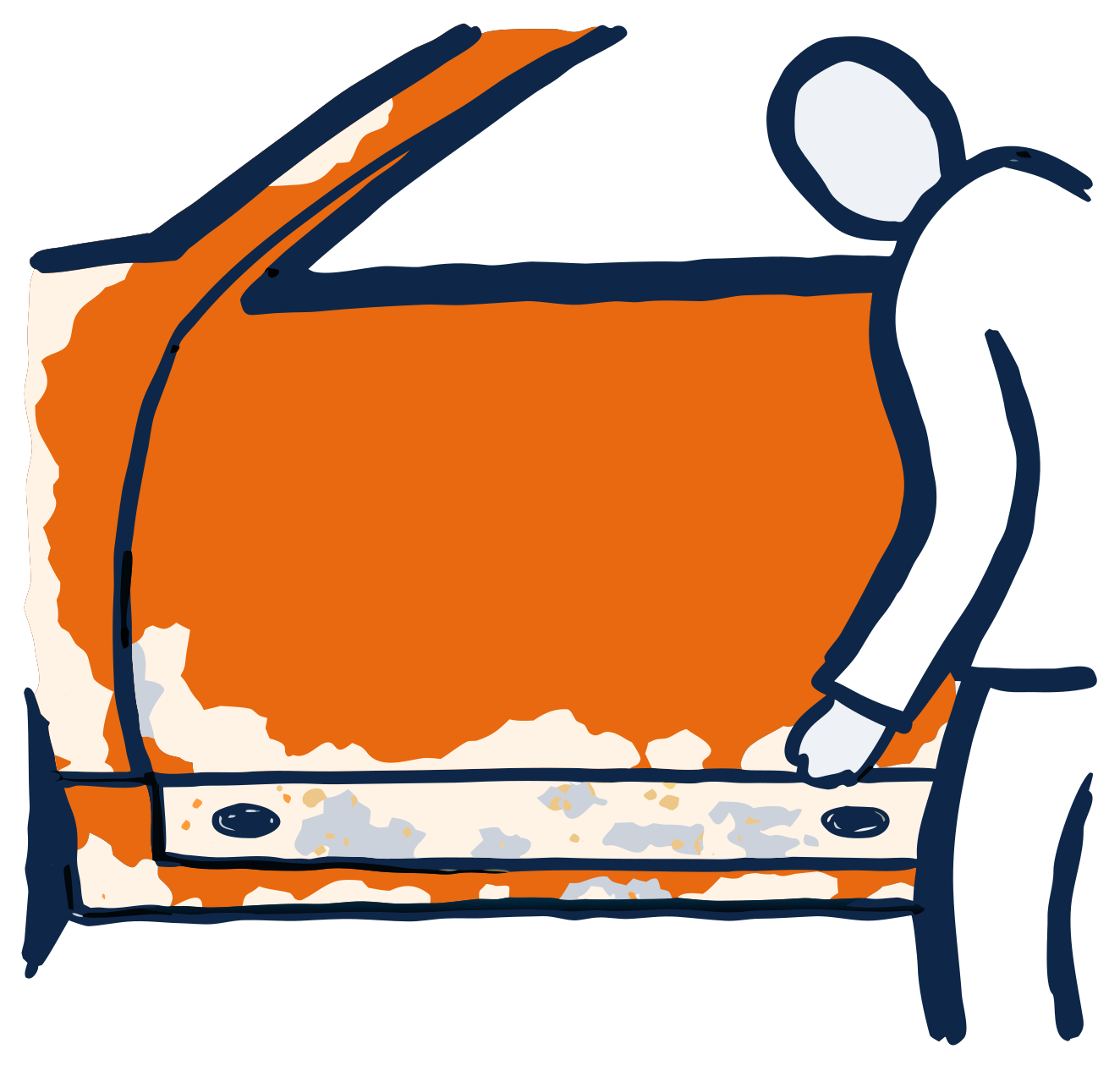
This is why rust often settles the question of whether the rest is worth repairing. A single worn part can be replaced as long as its mounting point is sound. Once the mounting point itself has corroded through, the job widens into welding, and the extent of it is not visible until the old part is off. Rust is also the only one of these categories that the week before the inspection can no longer affect at all.
The rest of the list is another matter. All of it fits into a single afternoon.
What to do to the car a week before
The order is worth reversing from the one used in the rush on the morning of the test. First deal with what stops the inspection altogether, and only then with what brings it down on the lift. There is just one thing in the first group, and it is settled online in a few minutes.
According to Traficom, a vehicle is placed under a ban on use if the annual vehicle tax is not paid by its due date, and a vehicle under a ban on use cannot be inspected. The ban is lifted once the overdue tax has been paid with interest. This is the only item on the list that stops the inspection before anyone has even looked at the car, and it is also the only one that cannot be put right on the spot. How the tax itself is made up has an article of its own.
On the day of the test itself there is very little left to do, and that is the point. Book a morning slot, so that any re-inspection can still be arranged for the same week, and drive the car up to temperature on the way. Clear the boot enough that the spare wheel well and the floor are visible. Everything else was dealt with a week earlier, and that is what the list is for.
- Check that no overdue annual vehicle tax is outstanding.
- Rock each wheel top and bottom with the car raised, and listen for knocks.
- Press each corner of the car down and see whether the body keeps rocking.
- Measure tread depth from the bottom of the main grooves at more than one point.
- Look at the edge of the brake disc between the spokes, and try the handbrake on a slope.
- Read the engine fault codes if the warning light has been on.
- Try every light, including the reversing, brake and number plate lights.
- Book the slot so that a month is left for a re-inspection before the due date.
Lights are the easiest item on the list and still the one most often left half done. The headlights get tried every dark evening, but the reversing light, the number plate light and one of the two brake lights are all things the driver never sees from the seat. Ask someone to press the brake and select reverse while you walk round the car. It takes two minutes and covers an entire defect category.
The list will not turn anyone into an inspector, and it is not meant to. It weeds out the failures that could have been spotted on your own drive, and leaves the garage what cannot be seen without a lift and proper equipment. The difference shows in the number of re-inspections, not in how well the car has been washed. The remaining items are worth going through at the same time as an oil change, since the car is up in the air anyway.
When repairing stops being worth it
Sooner or later you meet a car whose failure lines fall exactly where they recur in the older age groups: the suspension and the brakes. In both, the cost is labour rather than parts, and neither stays a one-off, because the same wear continues in the neighbouring joints and pipes. At that point the question is no longer whether you can get the car through this inspection, but how many times in a row you can, and what that comes to altogether.
The threshold is not the same for everyone, but the inspection certificate gives a better hint of it than the general look of the car. Repairing is the safer bet when there are one or two failure lines and no long column of repair notices beside them: the car is then sound apart from that one point. If the notices run to a dozen, the content of the next inspection is already known, and so is the one after that.
The answer comes from setting the cost of the repair against what the same money buys in another car. There is a steady supply of alternatives, and the number of them can be seen directly.
All current listings in total.
That same sum is worth doing before the garage visit rather than after it. Once the car is stripped and the parts ordered, the choice has been made whatever the bill turns out to say. Ask for the estimate in writing and set it against what a comparable car costs on the market right now. Both figures are available before anything has been unbolted.
One thing is worth keeping in mind when buying, too. The inspection date passes to the new owner with the car exactly as it stands, so a car bought just before its due date either passes its test in the first month of ownership or it does not. The listing will not tell you, but the date of the next inspection is on the registration certificate and can be checked before the deal is done. It is the cheapest check a used car buyer can make.